
Origami pop up cards represent a fascinating intersection of traditional Japanese paper folding and modern paper engineering. These three-dimensional greeting cards transform flat sheets of paper into architectural marvels that spring to life when opened. Whether you're a craft enthusiast, a greeting card designer, or a business looking to create memorable customer experiences, understanding the art and science behind these intricate creations opens up endless creative possibilities. The combination of precise folds, strategic cuts, and thoughtful design transforms simple paper into unforgettable messages that recipients treasure for years.
Mục Lục
- 1 Understanding the Art of Origami Pop Up Cards
- 2 Design Principles and Techniques
- 3 Material Selection and Quality Considerations
- 4 Popular Themes and Applications
- 5 Manufacturing Processes and Quality Control
- 6 Creative Customization and Personalization
- 7 Business Applications and Marketing Potential
- 8 Educational and Artistic Applications
- 9 Technical Challenges and Solutions
- 10 Sustainability and Environmental Considerations
- 11 Future Trends and Innovations
Understanding the Art of Origami Pop Up Cards
The foundation of origami pop up cards lies in the marriage of two distinct paper crafts: origami and kirigami. Traditional origami focuses exclusively on folding techniques without cutting, while kirigami incorporates strategic cuts to create intricate patterns. Pop up cards blend these approaches with paper engineering principles to create structures that collapse flat for mailing yet expand into impressive three-dimensional displays.
The key elements that define origami pop up cards include:
- Precise valley and mountain folds that create dimensional depth
- Strategic cuts that allow paper to move and transform
- Architectural principles that ensure stability when opened
- Symmetry and balance for smooth opening and closing mechanisms
- Layered complexity that reveals details as the card unfolds
The mathematical precision behind these cards is remarkable. According to research published in The Mathematical Intelligencer, the geometry underlying pop-up structures involves sophisticated calculations of angles, fold lines, and paper stress points. This scientific approach ensures that cards function reliably across hundreds or thousands of openings.
Historical Evolution and Modern Innovation
Pop up cards have evolved significantly since their earliest forms in the Victorian era. The evolution of pop-up cards traces their development from simple novelty items to sophisticated artistic expressions. In 2026, digital design tools combined with traditional craftsmanship have elevated these cards to new heights of complexity and beauty.
Modern origami pop up cards benefit from laser cutting technology that achieves precision impossible with hand cutting. This technological advancement allows manufacturers to create intricate designs with microscopic tolerances while maintaining the artistic essence of handcrafted cards. The result is consistent quality at scale without sacrificing the wow factor that makes each card special.
Design Principles and Techniques
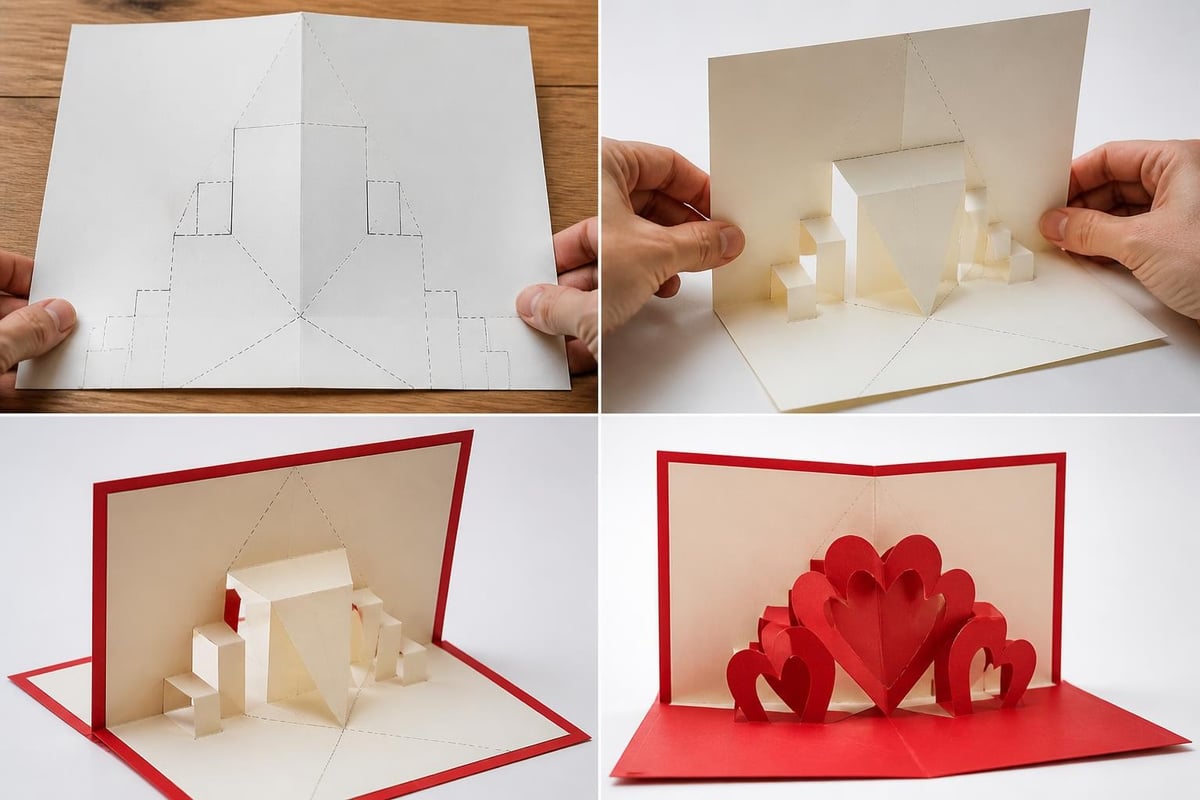
Creating effective origami pop up cards requires understanding fundamental design principles that govern how paper behaves under stress. The relationship between the card's base fold (typically 90 or 180 degrees) and the pop-up elements determines the final structure's stability and visual impact.
| Design Element | Function | Common Angle Range |
|---|---|---|
| Valley Folds | Create inward creases | 90-180 degrees |
| Mountain Folds | Create outward peaks | 90-180 degrees |
| Parallel Folds | Add depth layers | 30-90 degrees |
| V-Folds | Basic pop-up mechanism | 45-135 degrees |
Essential Folding Techniques
The V-fold serves as the cornerstone of most origami pop up cards. This technique involves creating two parallel fold lines that form a "V" shape when the card opens. The angle and length of these folds determine how far the pop-up element projects from the card base.
Advanced techniques expand creative possibilities:
- Layering: Multiple V-folds at different heights create depth perception
- Asymmetrical designs: Varying fold angles on each side produces dynamic movement
- Floating elements: Attachments at multiple points create suspended features
- Box folds: Four-sided structures that expand into geometric shapes
- Spiral formations: Curved cuts and folds generate rotating motion
For those new to paper engineering, step-by-step tutorials on designing pop-up cards provide valuable guidance. These resources break down complex structures into manageable steps, making advanced techniques accessible to beginners while offering experienced designers new perspectives on familiar methods.
Material Selection and Quality Considerations
The choice of paper dramatically affects both the appearance and functionality of origami pop up cards. Paper weight, texture, fiber direction, and coating all influence how well a design performs over time. Professional manufacturers typically use cardstock ranging from 200 to 300 GSM (grams per square meter) for optimal results.
Key material properties include:
- Weight: Heavier stock provides stability but requires more precise scoring
- Grain direction: Paper folds more cleanly along the grain
- Surface finish: Coated papers accept vibrant printing but may crack at folds
- Fiber content: Cotton-based papers offer superior longevity over wood pulp
- Color fastness: UV-resistant inks prevent fading in displayed cards
Testing materials before committing to large production runs saves costly mistakes. A design that works beautifully in 220 GSM uncoated stock might fail completely in 280 GSM glossy cardstock due to different flexibility characteristics. Handmade pop-up cards often experiment with mixed materials to achieve unique textures and visual effects.
Color Theory and Visual Impact
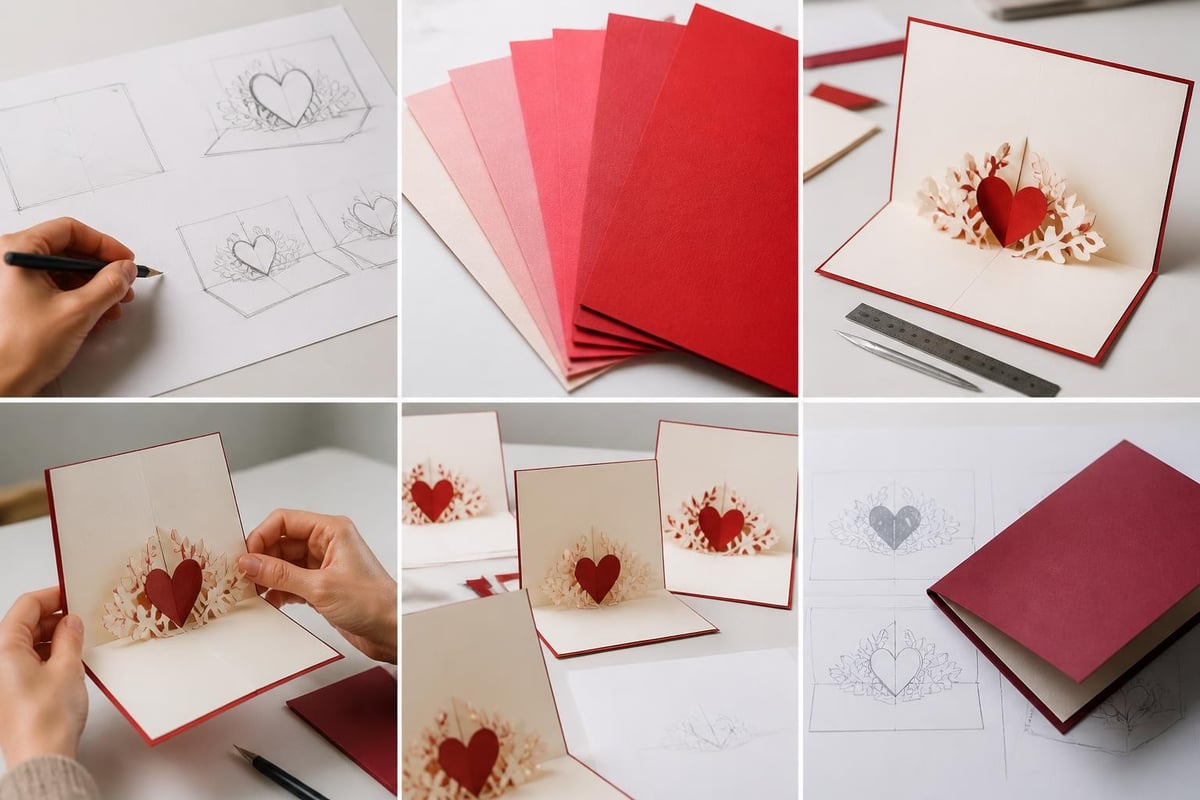
Color choices in origami pop up cards serve both aesthetic and functional purposes. Contrasting colors between the card base and pop-up elements enhance dimensional perception, making structures appear more dramatic. Monochromatic schemes create sophisticated, elegant effects that appeal to corporate clients and upscale markets.
The interplay of light and shadow on folded surfaces adds another dimension to color selection. White or light-colored papers emphasize sculptural qualities through shadow patterns, while darker colors create bold, graphic statements. Metallic finishes catch light differently at various viewing angles, adding dynamic visual interest as recipients handle the card.
Popular Themes and Applications
Origami pop up cards adapt to virtually any occasion or theme. The versatility of paper engineering allows designers to represent everything from architectural landmarks to natural forms, from abstract geometric patterns to representational imagery. Understanding which themes resonate with different audiences helps creators target their designs effectively.
Occasion-Specific Designs
Birthday celebrations remain the most common application for pop-up cards. Birthday pop-up designs range from whimsical cakes with multiple tiers to age-specific numbers that stand prominently when opened. These designs often incorporate interactive elements like pull tabs or rotating wheels that add playful engagement.
Wedding and anniversary cards favor romantic motifs including hearts, flowers, and architectural elements representing churches or ceremony venues. The permanence suggested by sophisticated paper engineering aligns perfectly with celebrating lasting relationships. Many couples preserve these cards as keepsakes, displaying them in homes as three-dimensional art pieces.
| Occasion | Popular Elements | Typical Complexity |
|---|---|---|
| Birthdays | Cakes, balloons, numbers | Medium |
| Weddings | Hearts, churches, rings | High |
| Holidays | Trees, snowflakes, ornaments | Medium-High |
| Congratulations | Trophies, stars, buildings | Medium |
| Sympathy | Flowers, doves, crosses | Low-Medium |
Corporate applications represent a growing segment of the origami pop up card market. Companies commission custom designs featuring their logos, products, or brand imagery for client appreciation, product launches, and special events. These cards serve dual purposes as marketing materials and memorable gifts that recipients rarely discard.
Manufacturing Processes and Quality Control
Professional production of origami pop up cards involves sophisticated equipment and skilled craftsmanship. While kirigami techniques can be executed by hand for small batches, commercial operations rely on precision machinery to achieve consistency across large quantities.
The manufacturing workflow typically includes:
- Digital design development using CAD software
- Prototype creation and structural testing
- Die-cutting or laser cutting setup
- Printing registration and color calibration
- Cutting and scoring operations
- Hand assembly of multi-layer elements
- Quality inspection at multiple checkpoints
- Packaging and protective shipping preparation
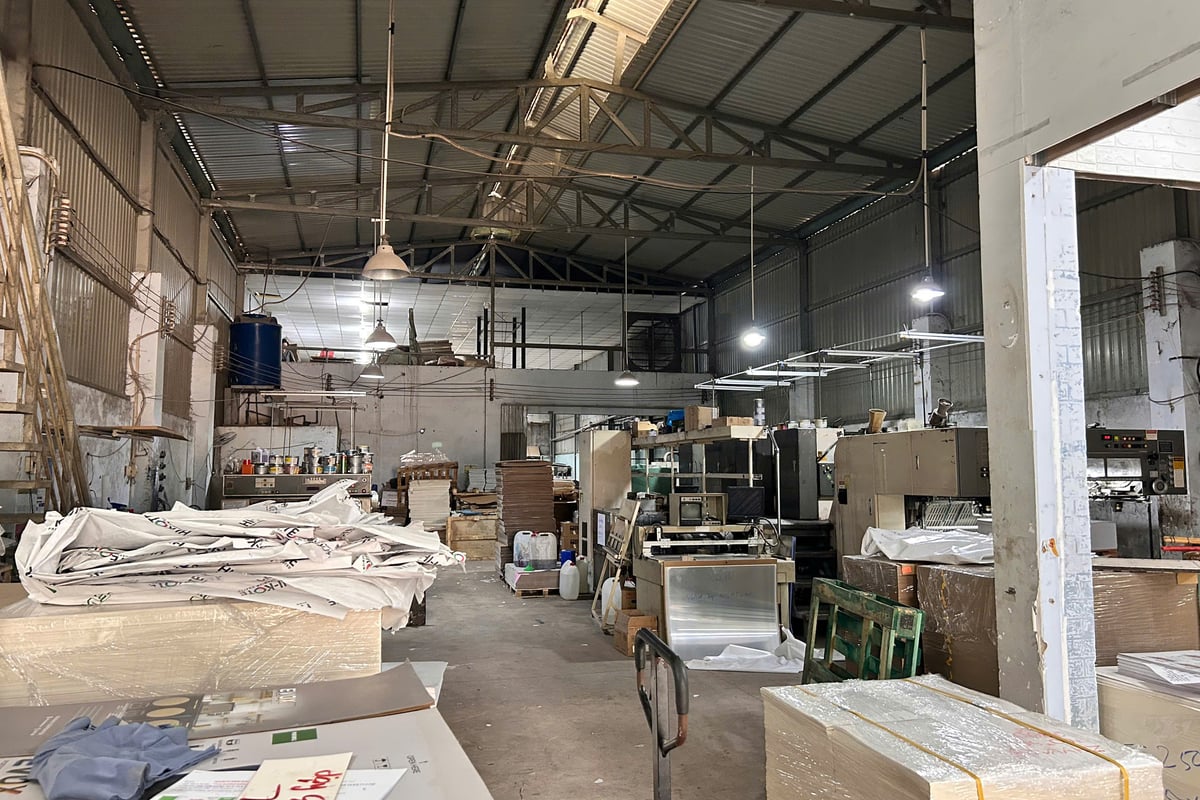
Laser cutting technology has revolutionized origami pop up card production. These systems achieve cutting precision within 0.1mm tolerances, enabling intricate details impossible with traditional die-cutting methods. The ability to score fold lines simultaneously with cutting operations streamlines production and ensures perfect alignment between cuts and folds.
For businesses seeking reliable suppliers, Vietnam has emerged as a leading manufacturing hub. Manufacturers specializing in pop-up cards combine advanced technology with skilled artisans trained in traditional paper crafts. The country's investment in modern production facilities alongside a heritage of paper artistry creates ideal conditions for high-quality output.
Working with a pop-up greeting card factory in Vietnam provides access to competitive pricing without compromising on quality standards. These facilities often maintain strict quality control processes and offer flexible OEM/ODM design services that accommodate both standard and highly customized requirements.
Quality Standards and Testing
Rigorous quality control ensures origami pop up cards perform consistently across their intended lifespan. Testing protocols evaluate multiple performance factors including fold endurance, paper tear resistance, color consistency, and dimensional accuracy. Professional manufacturers conduct opening/closing cycle tests, subjecting samples to hundreds of repetitions to verify structural integrity.
Environmental testing exposes cards to temperature and humidity variations that simulate storage and shipping conditions. Paper-based products are particularly sensitive to moisture, which can weaken adhesives and cause warping. Cards destined for international markets undergo accelerated aging tests to predict long-term appearance and functionality.
Creative Customization and Personalization
The trend toward personalized greeting cards has significantly impacted origami pop up card design. Advances in digital printing technology enable variable data printing, allowing each card in a production run to feature unique names, photos, or messages while maintaining identical pop-up structures. This capability appeals to both individual consumers and businesses conducting targeted marketing campaigns.
Customization options include:
- Personalized recipient names integrated into pop-up elements
- Custom color schemes matching brand identities or event themes
- Photo incorporation into flat and dimensional card areas
- Variable messages while maintaining consistent structural design
- Add-on elements like ribbons, beads, or pressed flowers
Personalized card design requires careful consideration of how customization affects manufacturing efficiency. Simple text changes executed through digital printing maintain fast turnaround times, while structural modifications necessitate new cutting dies and extended production schedules. Understanding these trade-offs helps designers balance uniqueness with practical constraints.
Seasonal and Holiday Variations
Holiday-specific origami pop up cards represent significant sales opportunities throughout the year. Christmas tree pop-up cards dominate winter holiday markets, with evergreen designs that incorporate traditional symbols like stars, ornaments, and presents. These cards often feature multiple layers creating forest scenes or elaborate decorated trees.
Valentine's Day drives demand for heart pop-up cards ranging from simple single-heart designs to complex interlocking or cascading heart formations. The symbolism of hearts emerging from flat paper resonates powerfully with romantic sentiment, making these designs perennial favorites.
Business Applications and Marketing Potential
Smart businesses recognize origami pop up cards as powerful marketing tools that cut through digital noise. In an era of email overload and social media saturation, a physical three-dimensional card commands attention in ways electronic messages cannot match. The tactile experience and visual surprise create memorable brand interactions that drive customer loyalty and word-of-mouth promotion.
Corporate Gift Programs
Companies implementing customer appreciation programs find pop-up cards deliver exceptional ROI. Unlike generic gifts that recipients quickly forget, well-designed cards become conversation pieces displayed prominently in offices and homes. This extended visibility provides ongoing brand exposure far beyond the initial interaction.
Effective corporate applications include:
- Anniversary milestone recognition for long-term clients
- Product launch announcements with miniature 3D product representations
- Trade show invitations that guarantee attendance through novelty value
- Executive holiday greetings that reflect company sophistication
- Employee recognition programs celebrating achievements
The investment in custom origami pop up cards signals that a company values relationships enough to commission unique, thoughtful communications. This perception of care and attention enhances brand positioning, particularly in luxury and premium market segments where differentiation is crucial.
Educational and Artistic Applications
Beyond commercial greeting cards, origami pop up techniques find applications in education and fine art. Teachers use pop-up structures to teach geometry, spatial reasoning, and engineering principles in engaging, hands-on formats. Students grasp abstract mathematical concepts more readily when they can physically manipulate folded paper models.
Origamic architecture represents the artistic pinnacle of this craft, where paper engineers create museum-quality pieces depicting famous buildings, natural scenes, and abstract compositions. These works blur the line between craft and fine art, commanding prices comparable to traditional artwork while demonstrating the medium's expressive potential.
Artists exploring this medium push boundaries by incorporating mixed media, experimenting with unconventional materials, and developing new folding techniques. The constraint of working with flat sheets that must collapse completely inspires innovative problem-solving and creative solutions that advance the entire field.
Technical Challenges and Solutions
Even experienced designers encounter challenges when developing complex origami pop up cards. Understanding common issues and their solutions accelerates the design process and prevents costly production errors.
| Challenge | Cause | Solution |
|---|---|---|
| Elements won't stay flat | Incorrect fold angles | Adjust parallel fold relationships |
| Tearing at fold lines | Insufficient scoring depth | Increase scoring pressure/depth |
| Asymmetric opening | Unbalanced structure | Ensure symmetrical element placement |
| Elements collide when closing | Inadequate clearance planning | Prototype testing and redesign |
| Paper curling | Humidity or grain direction | Climate control and grain alignment |
Prototyping remains essential for identifying structural problems before production. What appears functional in digital design may fail in physical form due to paper thickness, adhesive performance, or unforeseen mechanical interactions. Creating multiple iterations allows designers to refine mechanisms until they achieve reliable, smooth operation.
Computer-aided design software specifically developed for pop-up cards has simplified the prototyping process. These programs simulate how designs will behave when opened and closed, highlighting potential collision points and structural weaknesses before cutting any paper. However, physical prototypes still provide irreplaceable feedback on tactile qualities and overall user experience.
Sustainability and Environmental Considerations
Environmentally conscious consumers increasingly consider the ecological impact of greeting cards. Origami pop up cards made from recycled papers, sustainably harvested wood pulp, or alternative fibers like cotton or hemp appeal to this growing market segment. Manufacturers respond by sourcing certified sustainable materials and implementing waste reduction programs.
The durability of well-constructed pop-up cards actually supports sustainability goals. Unlike standard flat cards that recipients often discard quickly, dimensional cards command preservation as decorative objects or keepsakes. This extended lifespan means fewer cards needed over time, reducing overall environmental impact despite potentially higher resource investment per card.
Eco-friendly practices in pop-up card production:
- Using vegetable-based inks instead of petroleum derivatives
- Implementing zero-waste cutting optimization software
- Recycling production scrap into new paper stock
- Minimizing packaging through efficient structural design
- Sourcing papers from certified sustainable forestry operations
Companies promoting environmental responsibility find that highlighting sustainable practices in their pop-up card offerings resonates strongly with target audiences. Transparency about material sourcing and production methods builds trust and differentiates brands in competitive markets.
Future Trends and Innovations
The origami pop up card industry continues evolving through technological advancement and creative experimentation. Augmented reality integration represents an emerging frontier, where physical cards trigger digital content when viewed through smartphone cameras. This hybrid approach combines tangible appeal with unlimited digital storytelling potential.
Smart papers incorporating electronic components enable pop-up cards with embedded lights, sound modules, or motion sensors. While these additions increase production complexity and cost, they create unprecedented "wow factor" for premium applications. Luxury brands and high-end events justify the investment through enhanced memorability and social media sharing potential.
Artificial intelligence assists designers in generating novel pop-up mechanisms by analyzing thousands of existing designs and suggesting structural variations. These AI tools don't replace human creativity but accelerate the ideation process and help designers explore possibilities they might not consider independently. The combination of human artistic vision and machine computational power drives innovation forward.
Origami pop up cards blend artistic expression with engineering precision to create greeting cards that transcend ordinary communication. Whether you're crafting personalized messages or seeking to elevate your business's customer appreciation program, understanding the techniques, materials, and applications of these dimensional designs empowers you to create truly memorable experiences. The3dCards brings decades of paper engineering expertise and modern manufacturing capabilities to help you transform your vision into stunning three-dimensional reality, whether you need a single custom design or bulk orders for wholesale distribution.