
The greeting card industry has experienced a remarkable transformation over the past decade, with pop-up cards emerging as a premium category that combines traditional craftsmanship with modern design sensibilities. Among the brands that have captured consumer attention, FreshCut Paper has established a distinctive presence in this competitive market. Understanding what sets freshcut paper pop up cards apart requires examining the broader landscape of pop-up card manufacturing, design principles, and quality standards that define excellence in this specialized field.
Mục Lục
- 1 The Evolution of Premium Pop-Up Card Design
- 2 Material Selection and Sustainability Standards
- 3 Design Categories and Market Positioning
- 4 Quality Control and Manufacturing Standards
- 5 Customization and Personalization Options
- 6 Pricing Structures and Value Propositions
- 7 Market Trends and Consumer Preferences
- 8 Wholesale and Distribution Considerations
- 9 Comparing Market Options and Manufacturers
- 10 Technical Innovations in Pop-Up Card Production
The Evolution of Premium Pop-Up Card Design
Pop-up cards have evolved significantly from their origins in Victorian-era novelty items. Today's premium pop-up cards represent a sophisticated fusion of engineering principles and artistic vision, requiring careful consideration of structural mechanics, paper properties, and visual aesthetics. The modern pop-up card market demands innovation that balances complexity with reliability, ensuring that each card performs flawlessly when opened.
Engineering Foundations of Quality Pop-Up Cards
The structural integrity of a pop-up card depends on precise mathematical calculations and expert paper engineering. Each fold, crease, and attachment point must be positioned with exactitude to create smooth, predictable motion when the card opens. Professional manufacturers invest in high-precision laser cutting technology that ensures consistency across large production runs while maintaining the delicate tolerances required for complex three-dimensional structures.
Key engineering considerations include:
- Paper weight selection (typically 250-350 GSM for structural elements)
- Fold angle calculations for optimal pop-up action
- Stress point reinforcement to prevent tearing
- Balance distribution to ensure cards stand properly when opened
- Attachment point positioning for seamless integration

Manufacturing quality directly impacts the consumer experience. Cards that pop up smoothly and maintain their shape after multiple openings reflect superior engineering and material selection. The difference between premium freshcut paper pop up cards and lower-quality alternatives becomes immediately apparent in handling, with well-engineered cards demonstrating crisp folds and stable structures.
Material Selection and Sustainability Standards
The paper used in premium pop-up cards represents a critical quality differentiator. High-quality art paper provides the structural integrity necessary for complex designs while offering superior printability for vibrant colors and fine details. Material choices also carry environmental implications that increasingly influence consumer purchasing decisions.
| Material Aspect | Premium Standard | Impact on Quality |
|---|---|---|
| Paper Weight | 250-350 GSM | Structural stability, durability |
| Finish Type | Matte or subtle gloss | Print quality, tactile experience |
| Certification | FSC or equivalent | Environmental responsibility |
| Color Consistency | Batch-tested | Visual uniformity across orders |
Sustainable Production Practices
Modern consumers increasingly prioritize environmentally responsible greeting card options, pushing manufacturers to adopt sustainable practices without compromising quality. This shift has prompted innovation in materials sourcing, production methods, and waste reduction strategies.
Premium manufacturers now implement comprehensive sustainability programs that address every stage of production. These initiatives include responsibly sourced paper from certified forests, water-based inks that minimize environmental impact, and production processes designed to reduce waste. For businesses seeking to align with customer values, partnering with manufacturers committed to sustainability represents both an ethical choice and a strategic marketing advantage.
Design Categories and Market Positioning
Freshcut paper pop up cards have carved out a distinctive niche by focusing on specific design categories that resonate with contemporary consumers. Understanding these categories helps businesses select appropriate inventory and identify market opportunities.
Botanical and Nature Themes
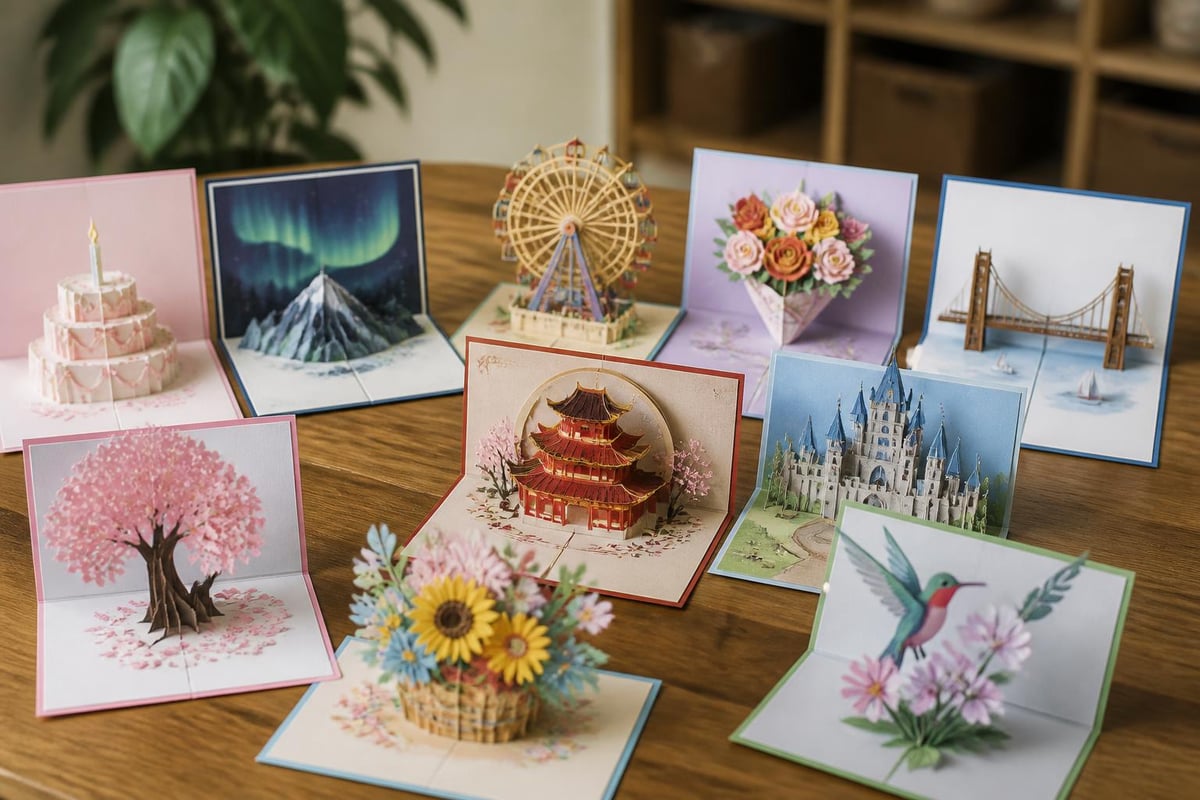
Nature-inspired designs dominate the premium pop-up card market, with floral arrangements representing particularly strong sellers across multiple occasions. These designs appeal to consumers seeking elegant, universally appreciated imagery that transcends specific celebrations. The three-dimensional nature of pop-up construction brings flowers and plants to life in ways that traditional flat cards cannot match.
Botanical pop-up cards require specialized design expertise to capture the organic forms of petals, leaves, and stems. The most successful designs balance botanical accuracy with artistic interpretation, creating sculptures that feel both realistic and stylized. For manufacturers like The3dCards, developing a robust portfolio of flower pop up cards addresses consistent market demand while showcasing technical capabilities.
Architectural and Structural Designs
Buildings, landmarks, and geometric structures provide another popular category for pop-up cards. These designs leverage the medium's strengths in creating precise, angular forms that would be impossible to achieve through traditional printing alone. From famous monuments to abstract architectural compositions, structural designs appeal to consumers seeking sophisticated, modern aesthetics.
Popular architectural themes include:
- Iconic city skylines and landmarks
- Religious structures for faith-based occasions
- Abstract geometric patterns
- Celebration venues and event spaces
- Seasonal structures like Christmas villages
Quality Control and Manufacturing Standards
The reputation of freshcut paper pop up cards rests on consistent quality control throughout the manufacturing process. Premium manufacturers implement multi-stage inspection protocols that catch defects before products reach consumers. These quality assurance measures separate professional operations from amateur producers.
Inspection Protocols
Professional manufacturing facilities establish comprehensive inspection checkpoints at critical production stages. Initial material inspection verifies paper quality, weight, and color consistency before production begins. During assembly, skilled artisans examine each card for proper fold alignment, adhesive application, and structural integrity. Final inspection confirms that finished cards meet all specifications before packaging.
| Inspection Stage | Key Checks | Acceptance Criteria |
|---|---|---|
| Material Receipt | Paper quality, color match | 100% specification compliance |
| Laser Cutting | Edge quality, dimension accuracy | ±0.2mm tolerance |
| Assembly | Fold alignment, adhesive placement | Zero visible defects |
| Function Testing | Pop-up action, stability | Smooth operation, no binding |
| Final Packaging | Complete set, damage-free | Perfect presentation |
Quality control extends beyond physical inspection to include performance testing. Cards undergo opening and closing cycles to verify durability and consistent action. This testing ensures that freshcut paper pop up cards deliver the premium experience consumers expect, even after repeated use.
Customization and Personalization Options
The ability to customize pop-up cards represents a significant value proposition for both retail and corporate buyers. Personalization transforms generic cards into memorable keepsakes that recipients treasure long after the occasion passes. Understanding customization capabilities helps businesses identify opportunities for differentiated offerings.
Corporate Customization Applications
Businesses increasingly recognize pop-up cards as powerful marketing tools that create lasting impressions. Custom designs incorporating company logos, products, or brand messages stand out dramatically from conventional corporate communications. The dimensional impact of a well-designed pop-up card commands attention and communicates professionalism in ways that flat cards cannot match.
Companies can leverage customization for various purposes including client appreciation, event invitations, product launches, and milestone celebrations. The investment in custom pop-up cards signals importance and attention to detail, strengthening relationships with key stakeholders. For businesses seeking to make unforgettable impressions, exploring custom creative pop-up greeting card options represents a strategic communication choice.
Personal Customization Features
Individual consumers also value personalization options that make cards uniquely theirs. Common customization features include:
- Name personalization on card fronts or interiors
- Custom message printing in coordinating fonts
- Color scheme adjustments to match event themes
- Photo integration within card designs
- Special occasion-specific elements
Advanced manufacturers offer flexible customization services that accommodate both large corporate orders and smaller personal requests. This versatility enables businesses to serve diverse customer segments with varying needs and budgets.
Pricing Structures and Value Propositions
Understanding the pricing dynamics of freshcut paper pop up cards helps businesses position products appropriately and set customer expectations. Premium pop-up cards command higher prices than conventional greeting cards, but this premium reflects genuine value differences that justify the investment.
Cost Factors in Pop-Up Card Production
Several elements contribute to the higher cost structure of quality pop-up cards compared to traditional flat cards. Material costs increase due to heavier paper requirements and higher paper consumption per unit. Manufacturing complexity demands skilled labor for assembly operations that cannot be fully automated. Design development requires specialized expertise in paper engineering beyond conventional graphic design capabilities.
Primary cost drivers include:
- Premium art paper and materials
- Precision laser cutting equipment and operation
- Skilled artisan assembly labor
- Complex multi-stage quality control
- Specialized packaging to protect dimensional structures
- Lower production volumes compared to flat cards
Despite higher unit costs, freshcut paper pop up cards deliver superior value through enhanced recipient experience, increased retention rates, and stronger emotional impact. Consumers perceive these cards as premium gifts worthy of higher investment for important occasions.
The components that justify premium pricing in quality pop-up cards, including materials, precision manufacturing, skilled assembly, and quality control processes
Market Trends and Consumer Preferences
The pop-up card market continues evolving as consumer preferences shift and new design possibilities emerge. Staying current with trends helps businesses maintain relevant product selections and anticipate future demand patterns.
Rising Demand for Experiential Products
Contemporary consumers increasingly value experiences over material possessions, a trend that benefits experiential products like pop-up cards. The surprise and delight of watching a flat card transform into a three-dimensional sculpture creates a memorable moment that recipients associate with the giver. This experiential quality positions freshcut paper pop up cards as premium choices for consumers seeking meaningful ways to mark important occasions.
Social media amplification has strengthened the appeal of visually striking cards. Recipients frequently photograph and share impressive pop-up cards online, extending their impact beyond the initial presentation. This viral potential adds marketing value for corporate users and social currency for individual senders.
Occasion-Specific Design Development
Market analysis reveals distinct design preferences across different occasions. Understanding these preferences enables manufacturers to develop targeted collections that resonate with specific buyer segments.
Birthday cards benefit from celebratory, colorful designs featuring cakes, candles, and festive imagery. Wedding and anniversary cards demand elegant, romantic themes with flowers, hearts, and sophisticated aesthetics. Holiday cards vary by cultural context, with Christmas designs emphasizing religious symbols, winter scenes, or Santa Claus imagery depending on target markets.
Wholesale and Distribution Considerations
For businesses considering freshcut paper pop up cards as inventory additions, understanding wholesale dynamics and distribution logistics ensures successful integration into existing operations.
Minimum Order Quantities and Pricing Tiers
Professional manufacturers typically establish minimum order quantities that reflect production efficiency requirements. These minimums vary based on whether buyers select stock designs or request custom creations. Stock designs generally require lower minimums since tooling and setup already exist. Custom designs demand higher minimums to justify the development investment.
Pricing structures usually incorporate volume tiers that reward larger commitments with better unit costs. Businesses planning seasonal inventory purchases can leverage these tiers to optimize margins while ensuring adequate stock levels for peak selling periods.
Storage and Display Requirements
Pop-up cards require more careful handling and storage than flat cards due to their dimensional nature. Retailers must allocate appropriate display space that protects cards while showcasing their unique features. Many successful retailers use sample cards in protective displays that customers can open and examine, with sealed inventory available for purchase.
Climate control considerations include maintaining consistent humidity levels to prevent paper warping and temperature stability to protect adhesives. These requirements align with general paper product storage best practices but deserve particular attention given the precision engineering in pop-up mechanisms.
Comparing Market Options and Manufacturers
The market for premium pop-up cards includes numerous manufacturers with varying capabilities, quality standards, and pricing structures. Evaluating options systematically helps businesses identify partners aligned with their quality requirements and business objectives.
Evaluation Criteria for Manufacturer Selection
When assessing potential suppliers of freshcut paper pop up cards, buyers should consider multiple factors beyond unit pricing. Manufacturing capability determines whether suppliers can handle custom requests and scale production for growing demand. Quality consistency ensures that orders meet expectations reliably over time. Communication responsiveness affects problem resolution and order management efficiency.
Geographic considerations influence shipping costs, lead times, and communication complexity. While domestic suppliers may offer simpler logistics, international manufacturers often provide cost advantages and specialized capabilities. Vietnam has emerged as a significant manufacturing hub for pop-up cards, with facilities offering competitive pricing alongside sophisticated production capabilities.
For businesses seeking reliable manufacturing partnerships, exploring established suppliers with proven track records minimizes risk. Manufacturers with comprehensive portfolios demonstrate versatility and experience across design categories. Those offering flexible customization services provide opportunities for differentiated product development.
Quality Benchmarks and Standards
Establishing clear quality standards before placing orders prevents misunderstandings and ensures satisfaction. Buyers should request samples that demonstrate manufacturing capabilities across relevant design categories. These samples reveal material quality, assembly precision, and functional performance under realistic conditions.
Key quality indicators include:
- Clean, precise laser cutting with no charring or rough edges
- Smooth, reliable pop-up action without binding or resistance
- Secure adhesive bonding that withstands repeated opening cycles
- Accurate color reproduction matching approved samples
- Proper fold formation that maintains crisp creases over time
Technical Innovations in Pop-Up Card Production
The pop-up card industry continues advancing through technological innovation that expands design possibilities and improves production efficiency. Understanding these developments helps businesses anticipate future capabilities and identify competitive advantages.
Digital Design and Prototyping
Modern pop-up card development increasingly relies on digital design tools that enable rapid prototyping and iteration. Three-dimensional modeling software allows designers to visualize how flat patterns will transform into dimensional structures before physical production. This digital preview capability accelerates development timelines and reduces material waste during the design refinement process.
Advanced manufacturers integrate mathematical modeling approaches that predict structural behavior and optimize fold patterns for reliable performance. These technical foundations ensure that ambitious designs translate successfully into functional products that meet quality standards.
Hybrid Construction Techniques
Innovation in freshcut paper pop up cards extends to hybrid construction methods that combine traditional paper engineering with contemporary materials and techniques. Some designs incorporate mixed media elements like fabric, ribbon, or metallic foils that add texture and visual interest. Others integrate LED lighting powered by thin batteries for illuminated effects that create dramatic presentations.
These hybrid approaches require careful engineering to maintain structural integrity while incorporating additional elements. Successful implementations enhance the card experience without compromising reliability or adding excessive bulk that complicates packaging and shipping.
Freshcut paper pop up cards represent a premium category where engineering precision, artistic design, and quality materials converge to create memorable experiences. By understanding the technical foundations, market dynamics, and quality standards that define excellence in this field, businesses can make informed decisions about product selection and supplier partnerships. Whether you're seeking to expand your greeting card offerings with premium options or develop custom designs for corporate applications, The3dCards provides the manufacturing expertise, quality commitment, and design flexibility to bring your vision to life with cards that leave lasting impressions.