
The evolution of greeting card manufacturing has reached new heights with laser cutting technology, transforming how we create personalized birthday celebrations. A birthday card laser cut with precision machinery offers intricate details and architectural complexity that traditional die-cutting simply cannot achieve. This technology combines artistic vision with engineering precision, allowing manufacturers and designers to produce stunning three-dimensional greetings that surprise and delight recipients from the moment they open the envelope.
Mục Lục
- 1 Understanding Laser Cut Birthday Card Technology
- 2 Design Considerations for Laser Cut Birthday Cards
- 3 Manufacturing Process for Laser Cut Birthday Cards
- 4 Advanced Techniques for Birthday Card Laser Cut Designs
- 5 Industry Applications and Market Trends
- 6 Technical Specifications and Equipment Considerations
- 7 Design Trends and Creative Innovation
- 8 Business Strategies for Manufacturers and Designers
Understanding Laser Cut Birthday Card Technology
Laser cutting has revolutionized the greeting card industry by enabling designs that were previously impossible or prohibitively expensive. The process uses a focused laser beam to cut through paper, cardstock, and specialty materials with accuracy measured in fractions of a millimeter. This precision makes birthday card laser cut designs particularly effective for creating pop-up mechanisms, layered artwork, and delicate patterns.
The technology works by directing a high-powered laser through a series of mirrors and lenses that focus the beam to an extremely small point. When this concentrated energy hits the paper surface, it vaporizes the material along the programmed cutting path. Modern laser cutting systems can process intricate designs for greeting cards at remarkable speeds while maintaining consistent quality across thousands of units.
Key advantages of laser cutting for birthday cards include:
- Precision cutting of intricate patterns and fine details
- Ability to create complex pop-up mechanisms with multiple layers
- Consistent quality across large production runs
- Rapid prototyping for custom designs
- Minimal material waste compared to traditional methods
- Clean edges without physical tool marks
The process differs fundamentally from traditional die-cutting because it requires no physical contact between the cutting tool and the material. This contactless approach eliminates issues like blade dulling, pressure marks, and registration errors that can plague conventional manufacturing methods.
Design Considerations for Laser Cut Birthday Cards
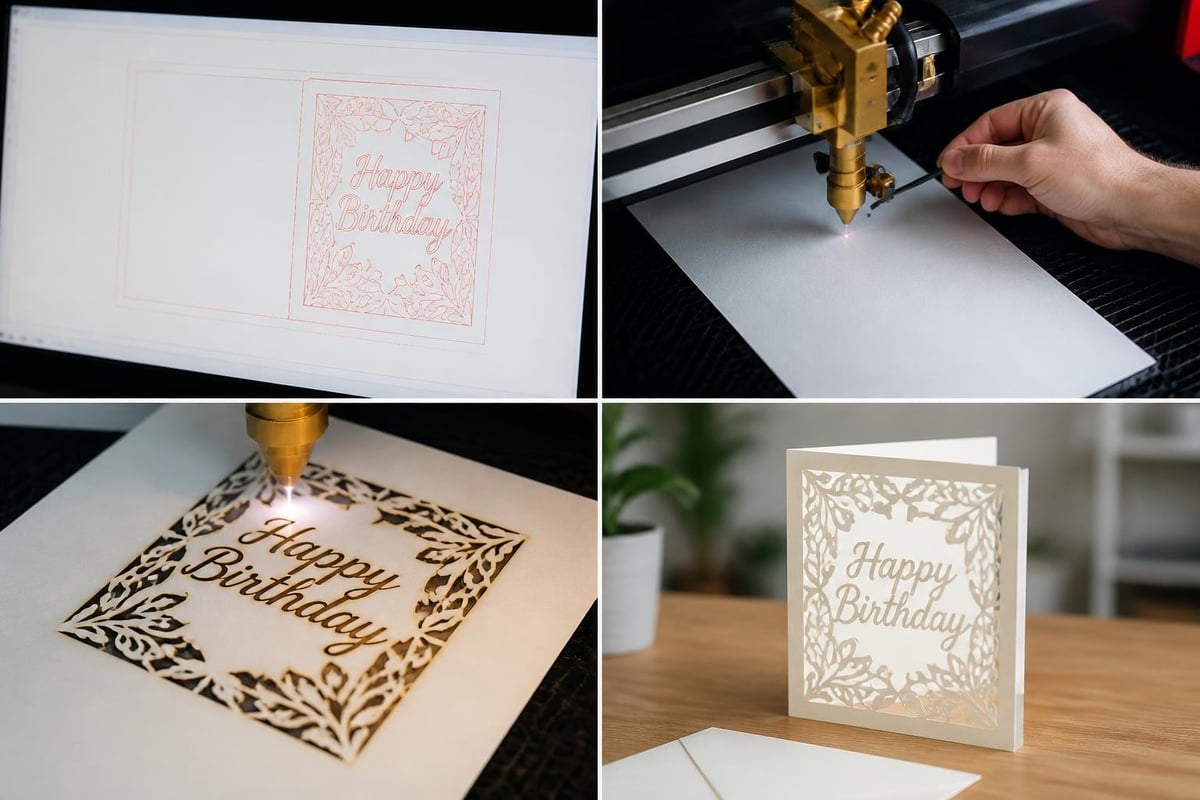
Creating an effective birthday card laser cut design requires understanding both the capabilities and limitations of the technology. Designers must consider line thickness, spacing between elements, and structural integrity when developing patterns that will translate well to physical products. Proper design preparation ensures clean cuts and prevents common issues like charring or incomplete separation.
Vector File Preparation
All laser cutting begins with a properly formatted vector file, typically in formats like SVG, AI, or DXF. These files contain mathematical descriptions of lines and curves rather than pixel-based images, allowing the laser to follow precise paths. Line colors within the vector file often indicate different laser settings: red lines might represent cuts, while blue lines indicate scoring or engraving.
Critical design parameters include:
- Minimum line spacing of 0.5-1mm to prevent structural weakness
- Corner radius design to reduce stress concentration
- Proper nesting of parts to minimize material waste
- Strategic placement of fold lines and score marks
- Consideration of paper grain direction for pop-up mechanisms
Material Selection and Testing
The choice of paper or cardstock significantly impacts the final quality of a birthday card laser cut product. Materials range from standard 200-300gsm cardstock to specialty papers with metallic finishes, textured surfaces, or embedded fibers. Each material interacts differently with the laser beam, requiring specific power and speed settings to achieve optimal results.
Testing different paper stocks reveals how materials respond to laser energy. Some papers cut cleanly with minimal discoloration, while others may brown along the edges or produce smoke residue. Avoiding burn marks requires careful calibration of laser settings and sometimes protective techniques like masking tape application.
| Material Type | Weight (gsm) | Laser Settings | Best For |
|---|---|---|---|
| Standard Cardstock | 200-250 | Medium power, high speed | Simple cuts, bulk production |
| Premium Art Paper | 250-300 | Low power, medium speed | Fine details, minimal charring |
| Metallic Paper | 200-220 | Very low power, slow speed | Decorative accents, luxury cards |
| Textured Cardstock | 280-350 | High power, slow speed | Structural elements, bases |
Manufacturing Process for Laser Cut Birthday Cards
The production workflow for birthday card laser cut products involves several stages, from initial concept development through final assembly and quality control. Professional manufacturers optimize each step to balance production speed, quality standards, and cost efficiency. Understanding this workflow helps designers create products that manufacture efficiently while maintaining artistic integrity.
Digital Design to Physical Prototype
The journey begins with concept sketches or digital designs that capture the intended birthday theme and pop-up mechanism. Designers use CAD software or specialized programs like Inkscape to develop the cutting patterns, fold lines, and assembly guides. Creating oversized or complex designs requires particular attention to structural engineering principles.
Once the digital file is complete, the first prototype undergoes test cutting on sample materials. This prototype reveals whether the design assembles correctly, whether tolerances are appropriate, and whether the pop-up mechanism functions smoothly. Adjustments often focus on hinge points, layer spacing, and the interaction between different moving parts.
Production Scaling and Quality Control
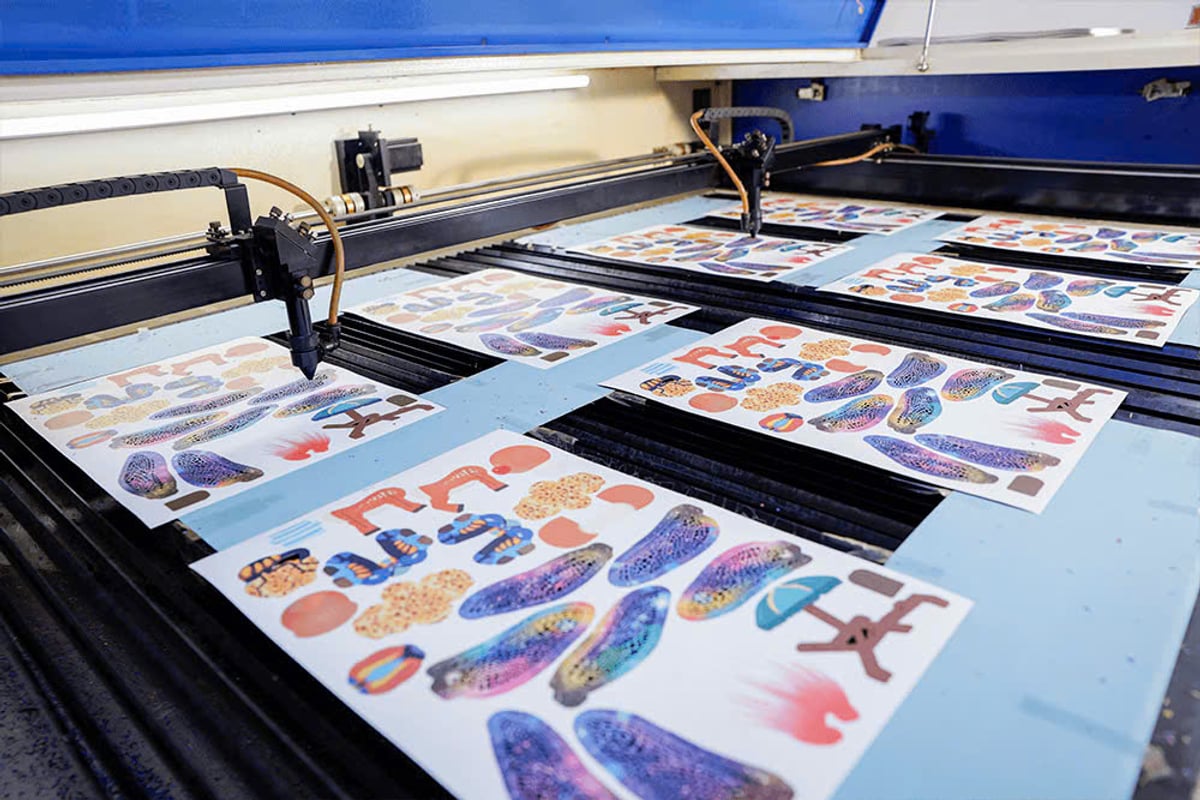
For manufacturers producing birthday card laser cut products at scale, consistency becomes paramount. Industrial laser systems can process dozens of cards per hour, but maintaining quality across large batches requires systematic quality control protocols. Each production run begins with calibration tests to ensure the laser settings match the specific batch of paper being used.
Production workflow stages:
- Material preparation and inspection for defects
- Laser system calibration and test cuts
- Batch cutting with periodic quality checks
- Edge inspection and cleaning of residue
- Sorting and organizing cut components
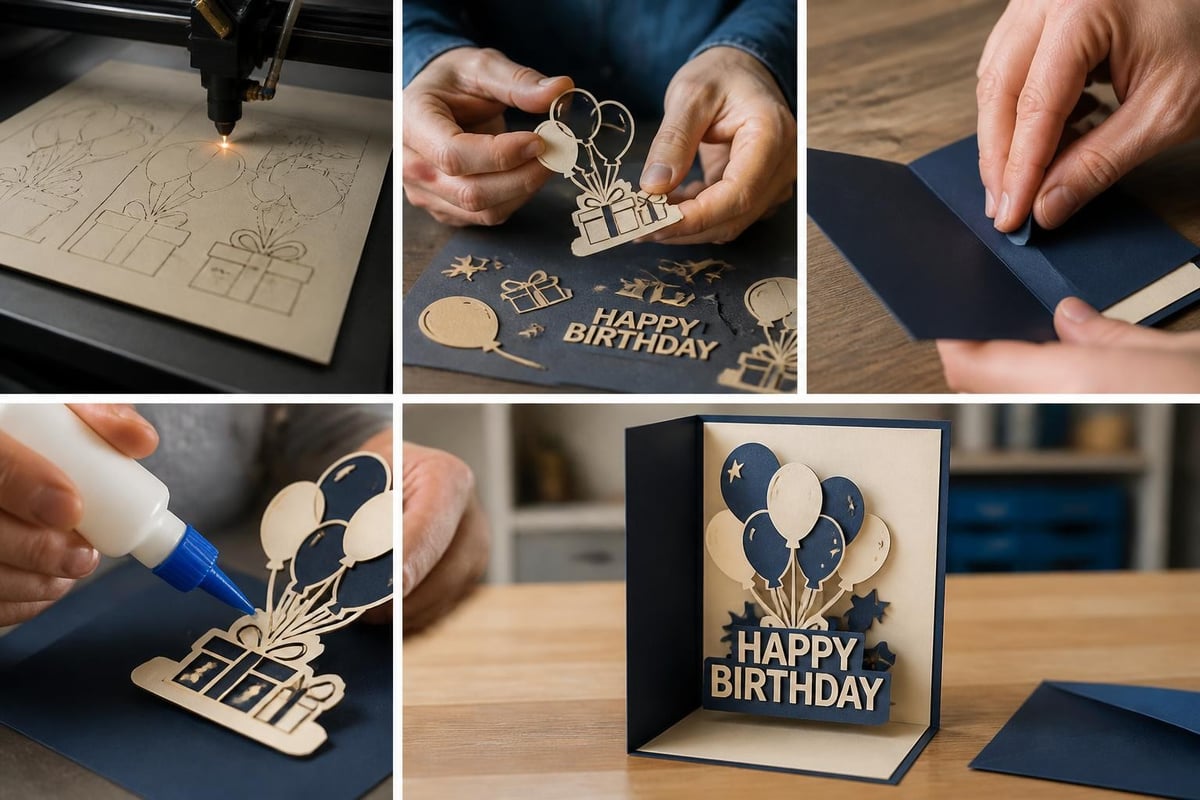
- Manual assembly of pop-up mechanisms
- Final inspection before packaging
The assembly stage often requires skilled hand work, particularly for complex pop-up birthday cards with multiple layers and intricate mechanisms. Artisans apply adhesive precisely, align layers carefully, and test each mechanism to ensure smooth operation. This combination of high-tech cutting and traditional craftsmanship produces the highest quality results. For those looking to work with experienced manufacturers, partnering with a Pop up greeting card factory in Vietnam provides access to skilled artisans and competitive pricing.
Advanced Techniques for Birthday Card Laser Cut Designs
Beyond basic cutting, advanced laser systems offer additional capabilities that enhance birthday card designs. Engraving creates surface texture and images without cutting through the material, while scoring produces fold lines that guide precise assembly. Variable power settings allow a single machine to perform multiple operations in one pass, increasing efficiency and design possibilities.
Three-Dimensional Pop-Up Engineering
The most impressive birthday card laser cut designs incorporate sophisticated pop-up mechanisms that transform flat sheets into architectural sculptures. These mechanisms rely on precise geometry, with cuts and folds positioned to create specific movements when the card opens. Common mechanisms include V-folds, parallel folds, box folds, and floating layers.
Designing 3D birthday cards requires understanding how angles and distances affect the final structure. A 90-degree V-fold creates a simple pop-up that rises perpendicular to the card base, while more acute angles produce different standing heights. Designers use paper engineering principles to calculate these relationships mathematically.
Popular pop-up mechanisms for birthday cards:
- V-fold pop-ups: Simple mechanism with elements attached to two opposing folds
- Parallel fold pop-ups: Multiple layers rising in parallel planes
- Box mechanisms: Creating cubic or rectangular structures
- Rotating elements: Parts that spin or unfold in unexpected ways
- Layered scenes: Multiple depth planes creating dimensional landscapes
- Compound mechanisms: Combining multiple techniques in one design
Personalization and Customization Options
Modern laser systems enable mass customization, where each birthday card laser cut in a production run can feature unique personalized elements. Variable data printing combined with laser cutting allows names, ages, dates, and custom messages to appear in each card without slowing production. This capability transforms generic greetings into meaningful personal connections.
The customization extends beyond text to include custom-cut elements that reflect the recipient's interests. A card for a golf enthusiast might feature laser-cut golf clubs and balls, similar to designs like the 3D pop-up golf cart card. The laser can cut these personalized elements with the same precision as standard patterns, making true one-of-a-kind designs commercially viable.
Industry Applications and Market Trends
The birthday card laser cut market spans multiple customer segments, from individual consumers seeking unique greetings to corporate clients ordering bulk custom cards for client appreciation programs. Each segment has distinct requirements regarding design complexity, personalization levels, and price points. Understanding these market dynamics helps manufacturers position their offerings effectively.
Commercial and Retail Distribution
Retail greeting card companies increasingly incorporate laser-cut elements to differentiate their products in a competitive marketplace. Premium birthday cards command higher retail prices, and laser cutting technology in graphic arts enables intricate designs that justify those premiums. Cards featuring laser-cut elements typically retail for two to five times the price of standard printed cards.
Wholesale distribution channels prefer designs that balance visual impact with production efficiency. A birthday card laser cut design that requires minimal assembly time while delivering impressive results becomes a strong seller for distributors. Manufacturers develop product lines with various complexity levels to serve different market segments.
| Market Segment | Design Complexity | Production Volume | Customization Level |
|---|---|---|---|
| Mass Retail | Low to Medium | 10,000+ units | Minimal |
| Specialty Boutiques | Medium to High | 1,000-5,000 units | Moderate |
| Custom Corporate | High | 500-2,000 units | Extensive |
| Individual Orders | Variable | 1-100 units | Complete personalization |
Corporate and Event Applications
Businesses utilize birthday card laser cut products for employee recognition programs, client appreciation initiatives, and corporate celebrations. These applications often require brand integration, with company logos and colors incorporated into the design. The precision of laser cutting ensures consistent brand representation across all units.
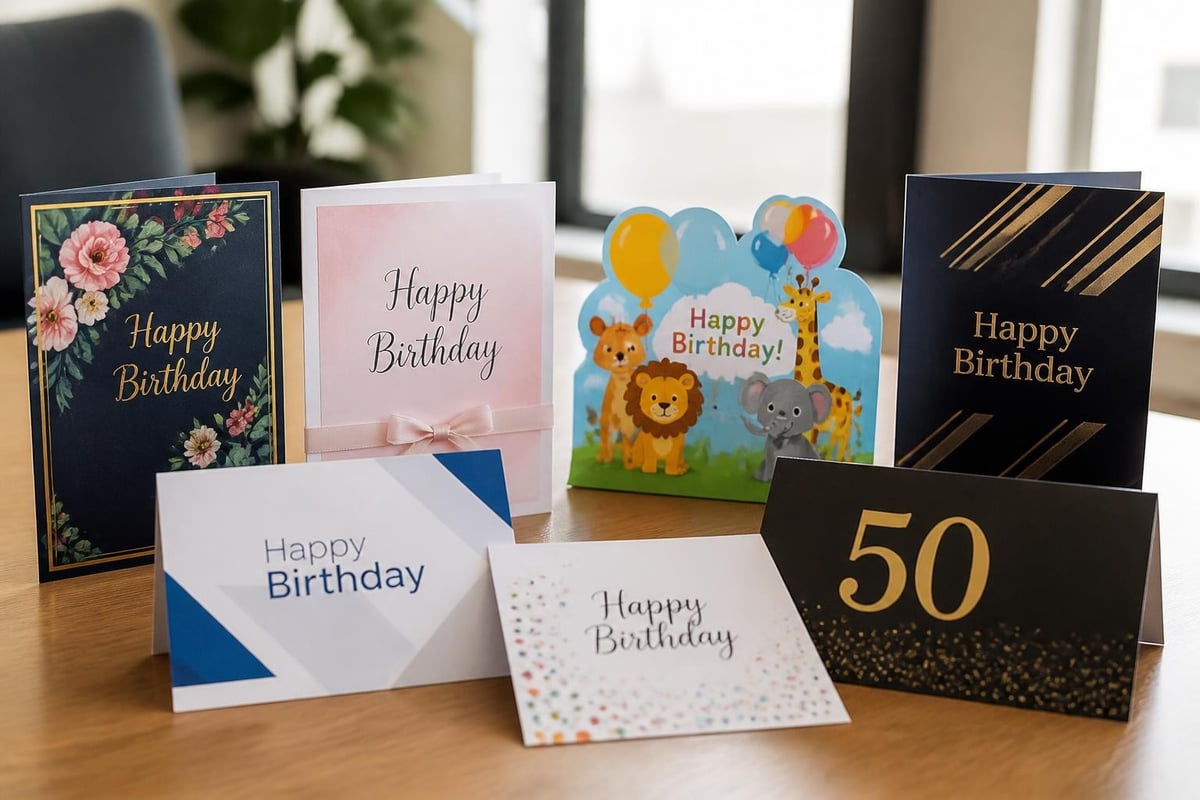
Event planners commission custom birthday cards for milestone celebrations, where the card itself becomes a keepsake commemorating the occasion. A 50th birthday celebration might feature a card with the number "50" cut in an ornate pattern, while a child's party could showcase favorite characters or themes laser-cut in vibrant colors.
Technical Specifications and Equipment Considerations
Selecting appropriate laser cutting equipment for birthday card production requires evaluating several technical factors. CO₂ lasers remain the industry standard for paper cutting due to their wavelength characteristics, which materials absorb efficiently. Power levels typically range from 30 to 150 watts, with higher power enabling faster cutting speeds or processing of thicker materials.
Machine Capabilities and Features
Professional birthday card laser cut production benefits from machines with specific features beyond basic cutting capability. Camera registration systems align cuts perfectly with pre-printed elements, enabling print-and-cut workflows where color printing combines with laser-cut details. Conveyor systems increase throughput by automatically feeding materials through the cutting area.
Essential features for professional production:
- High-resolution cutting head (minimum 1000 DPI equivalent)
- Automatic focus adjustment for varying material thicknesses
- Air assist systems to remove cut debris and prevent charring
- Camera registration for print-to-cut alignment
- Robust exhaust and filtration systems for paper dust
- Rotary attachments for cylindrical or curved surfaces
Software capabilities matter as much as hardware specifications. Professional laser systems integrate with design software and production management systems, enabling efficient workflow from order receipt through shipping. Some systems include automated nesting algorithms that optimize material usage by arranging multiple designs efficiently on each sheet.
Maintenance and Operating Costs
Operating a birthday card laser cut production facility involves ongoing costs beyond the initial equipment investment. Consumables include laser tubes (which require periodic replacement), focusing lenses, mirrors, and air filters. Regular maintenance schedules prevent downtime and ensure consistent cut quality across production runs.
Energy consumption varies with laser power and duty cycle, but typically ranges from one to three kilowatts during active cutting. Ventilation systems add additional power requirements. When calculating production costs, manufacturers must account for material waste, labor for assembly and quality control, and equipment depreciation alongside direct operating expenses.
Design Trends and Creative Innovation
Current trends in birthday card laser cut design reflect broader shifts in consumer preferences toward personalization, sustainability, and experiential products. Minimalist geometric patterns appeal to modern aesthetic sensibilities, while intricate Victorian-inspired flourishes satisfy traditional tastes. Successful manufacturers offer diverse design portfolios that serve multiple style preferences.
Sustainable Materials and Practices
Environmental consciousness increasingly influences material selection for birthday cards. Recycled cardstock, FSC-certified papers, and biodegradable materials respond to consumer demand for sustainable products. Laser cutting supports sustainability by minimizing material waste through efficient nesting and precise cutting that leaves no scrap from die wear or misalignment.
Some manufacturers experiment with alternative materials beyond traditional paper, including thin wood veneers, cork, and fabric. These materials create unique textures and visual effects in birthday card laser cut designs, though each requires specific laser settings and handling procedures. Testing remains essential when introducing new materials to production.
Interactive and Multisensory Elements
The latest birthday card innovations combine laser cutting with other technologies to create multisensory experiences. LED lights embedded in laser-cut patterns illuminate when the card opens, while sound modules play birthday songs or personalized voice messages. These enhanced cards command premium prices and create memorable unboxing experiences, as seen in products like the pop-up musical lighted birthday cards.
Movement mechanisms add another dimension to birthday card laser cut designs. Cards featuring wheels, sliders, or pull-tabs engage recipients through interaction. The precision of laser cutting enables the tight tolerances these mechanisms require, with moving parts fitting together smoothly without binding or excessive play.
Business Strategies for Manufacturers and Designers
Successfully commercializing birthday card laser cut products requires strategic thinking about product development, pricing, and market positioning. Manufacturers must balance production efficiency with design innovation, while designers need to understand manufacturing constraints to create viable products. Collaboration between creative and production teams produces the best results.
Portfolio Development and Market Testing
Building a successful product line begins with market research to identify underserved niches and trending themes. A birthday card laser cut collection might include categories like milestone birthdays, specific hobbies, popular culture references, and timeless designs. Each category should contain multiple designs at different price points to serve varied customer budgets.
Prototyping and market testing reveal which designs resonate with target audiences before committing to large production runs. Small batch releases through online marketplaces or craft fairs provide direct customer feedback. Successful designs scale to larger production, while underperforming concepts undergo revision or retirement.
Effective portfolio strategies:
- Seasonal collections released quarterly to maintain freshness
- Customizable templates that enable personalization without custom cutting
- Licensed character designs for recognizable intellectual properties
- Collaboration with artists for limited edition releases
- Modular design systems where components combine in multiple ways
Pricing and Value Proposition
Pricing birthday card laser cut products requires accounting for all production costs while remaining competitive within target market segments. Handmade elements, premium materials, and complex mechanisms justify higher prices, but the perceived value must align with the price point. Clear communication about the craftsmanship, materials, and technology involved helps customers understand the value proposition.
Volume pricing encourages bulk orders from corporate clients and event planners. Tiered pricing structures offer discounts at specific quantity thresholds while maintaining profitability. Custom design services command premium pricing, reflecting the additional design time and unique nature of bespoke creations.
The birthday card laser cut industry continues to evolve as technology advances and consumer preferences shift toward meaningful, personalized greetings. Mastering the technical aspects of laser cutting while staying attuned to design trends and market demands positions manufacturers for success in this competitive yet rewarding field. Whether you're creating cards for retail distribution, corporate clients, or individual celebrations, The3dCards offers professional manufacturing expertise and custom design services to bring your vision to life with precision and artistry.