
The greeting card industry has witnessed a remarkable transformation over the past decade, with laser cutting technology revolutionizing how manufacturers create intricate, personalized designs. Laser cut birthday cards represent the perfect intersection of traditional craftsmanship and modern precision engineering, offering consumers unique, memorable ways to celebrate special occasions. This technology enables manufacturers to produce complex patterns, delicate three-dimensional structures, and personalized elements that would be impossible or prohibitively expensive with conventional die-cutting methods. As consumer demand for distinctive, high-quality greeting cards continues to grow in 2026, understanding the capabilities and applications of laser cutting has become essential for manufacturers and retailers alike.
Mục Lục
- 1 The Technology Behind Laser Cut Birthday Cards
- 2 Design Principles for Laser Cut Cards
- 3 Production Techniques and Quality Control
- 4 Customization and Personalization Options
- 5 Market Trends and Consumer Preferences in 2026
- 6 Manufacturing Excellence and Business Applications
- 7 Technical Advancements Shaping the Future
- 8 Design Resources and Learning Pathways
- 9 Quality Standards and Best Practices
The Technology Behind Laser Cut Birthday Cards
Laser cutting technology uses focused beams of light to cut through materials with exceptional precision, creating clean edges and intricate details that elevate birthday card designs to new artistic heights. The process involves computer-controlled systems that follow vector-based designs, allowing manufacturers to reproduce complex patterns consistently across large production runs.
Modern laser cutting systems operate at various power levels and speeds depending on the material being processed. For paper-based birthday cards, CO2 lasers typically operate between 40 and 150 watts, providing sufficient power to cut through multiple layers while maintaining fine detail. The precision of these machines reaches tolerances of 0.1mm or better, enabling designers to create delicate filigree patterns, intricate pop-up mechanisms, and layered dimensional effects.
Material Selection for Optimal Results
Choosing the right materials is crucial for producing high-quality laser cut birthday cards that meet both aesthetic and durability standards. Different paper stocks respond differently to laser cutting, and understanding these properties helps manufacturers achieve optimal results.
Premium materials for laser cut birthday cards include:
- Heavy cardstock (250-350 gsm) for structural stability
- Art paper with smooth finishes for vibrant color reproduction
- Specialty metallic papers for elegant accents
- Textured papers that add tactile interest
- Translucent vellum for layering effects
According to material compatibility guides, paper products respond exceptionally well to laser cutting, producing clean edges without the charring common in some materials. The key is matching the laser power and speed settings to the specific paper weight and composition. Heavier stocks require slower cutting speeds or multiple passes, while lightweight papers need reduced power to prevent burning.
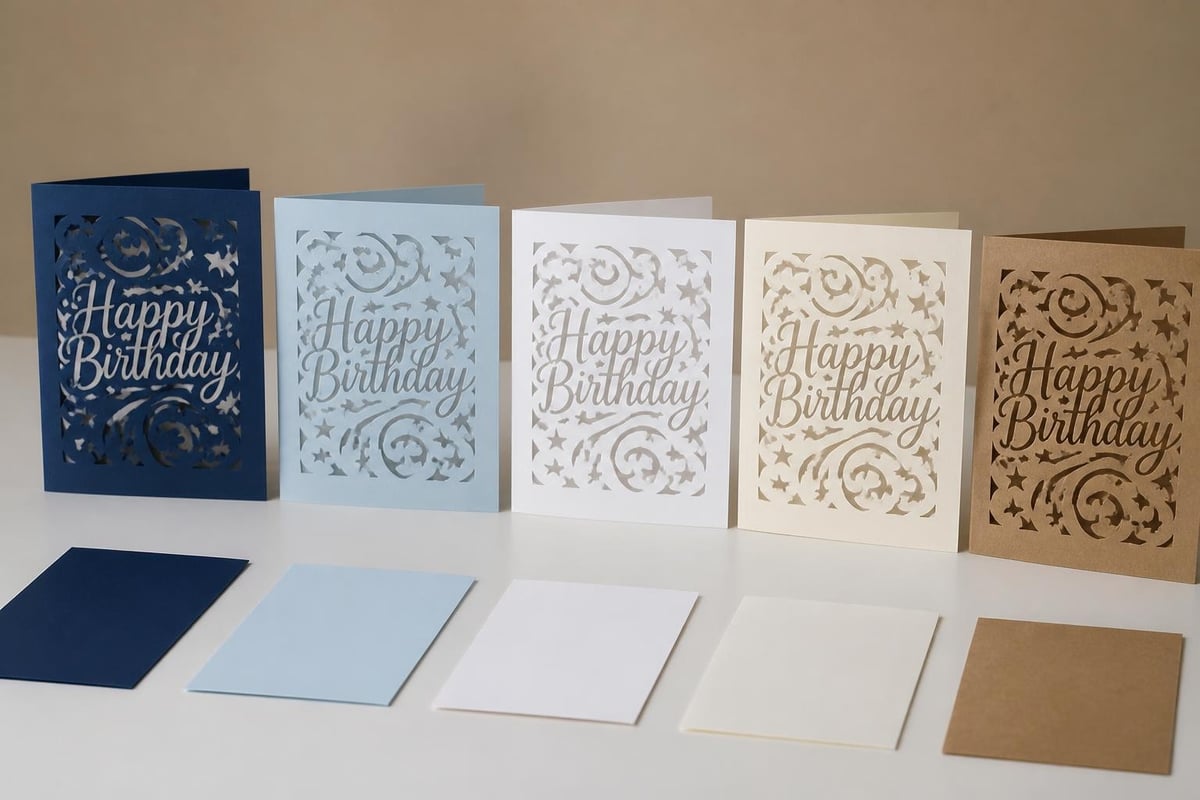
The selection process also involves considering the card's intended use and shipping requirements. Cards designed for retail display need sufficient rigidity to stand upright, while those intended for mailing require flexibility to fit standard envelopes without damage.
Design Principles for Laser Cut Cards
Creating effective designs for laser cut birthday cards requires understanding both the capabilities and limitations of laser cutting technology. Designers must balance visual appeal with structural integrity, ensuring that intricate patterns don't compromise the card's durability.
Structural Considerations
The most successful laser cut birthday cards incorporate design elements that enhance rather than weaken the overall structure. This involves strategic placement of cut patterns, maintaining sufficient connection points, and understanding how different cuts affect paper strength.
| Design Element | Recommended Approach | Common Pitfall |
|---|---|---|
| Connection Points | Minimum 3mm width for stability | Over-delicate bridges that tear |
| Cut Spacing | 2mm minimum between parallel cuts | Cuts too close causing warping |
| Border Width | 5-10mm solid margins | Insufficient edge support |
| Layer Alignment | Precise registration marks | Misaligned multi-layer assemblies |
When developing patterns for three-dimensional pop-up effects, designers must account for the folding mechanics and stress points. The integration of score lines, partial cuts, and through-cuts creates the foundation for successful pop-up mechanisms that spring to life when the card opens.
Vector File Preparation
Professional laser cut birthday cards begin with properly prepared vector files that communicate precise cutting instructions to the machine. Design software like Adobe Illustrator, CorelDRAW, or specialized CAD programs enables creators to develop detailed cutting paths with appropriate line weights and colors.
Essential vector file specifications:
- Cut lines defined as hairline strokes (0.001pt)
- Engrave areas specified with filled shapes or thicker lines
- Score lines designated with distinct colors or line styles
- All text converted to outlines to prevent font substitution
- Artwork organized in layers for multi-stage cutting
- File dimensions matching final card size plus bleed allowance
The design preparation process requires attention to detail that goes beyond traditional print design. Each line in the vector file represents a physical action the laser will perform, making precision crucial at every stage.
Production Techniques and Quality Control
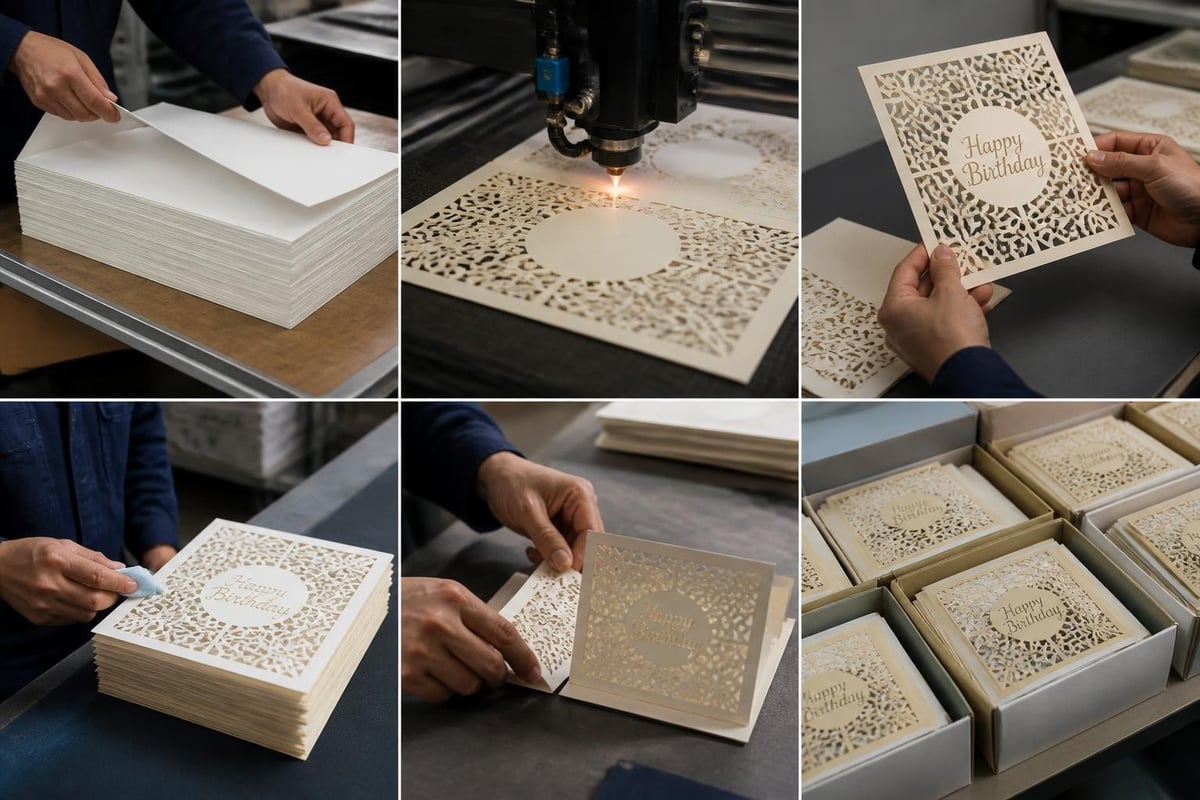
Manufacturing laser cut birthday cards at scale demands systematic processes that maintain consistency while allowing for customization and personalization. The production workflow integrates digital design, automated cutting, and skilled hand assembly to create finished products.
Machine Settings and Calibration
Achieving consistent results across production runs requires careful calibration of laser cutting equipment and documentation of optimal settings for each material type. Manufacturers typically develop comprehensive settings libraries that specify power, speed, and frequency parameters for different papers and designs.
For standard 300 gsm cardstock, typical settings might include 60-70% power at speeds of 30-50mm/second, with frequency adjusted based on the specific laser system. However, these parameters vary significantly based on equipment manufacturer, laser tube condition, and environmental factors like humidity.
Regular maintenance and calibration ensure that laser cut birthday cards meet quality standards throughout extended production periods. This includes cleaning optical components, checking beam alignment, and verifying cutting precision against reference templates.
Assembly and Finishing
While laser cutting automates the pattern creation process, many premium laser cut birthday cards require skilled hand assembly to achieve their full three-dimensional effect. Artisans carefully fold, glue, and position elements according to design specifications, transforming flat cut sheets into dimensional greetings.
The assembly process for complex pop-up mechanisms demands precision and attention to detail. Workers must align multiple layers perfectly, apply adhesive in exact amounts, and ensure that folding mechanisms operate smoothly through repeated openings and closings. This combination of automated precision cutting and handcrafted assembly creates products with both technical excellence and artisanal quality.
Quality control inspections occur at multiple stages, examining cut quality, assembly accuracy, and functional testing of pop-up mechanisms. Cards that don't meet specifications are flagged for correction or removal from inventory.
Customization and Personalization Options
The flexibility of laser cutting technology makes it ideal for creating customized and personalized birthday cards that resonate with specific recipients. Unlike traditional die-cutting methods that require expensive tooling for each design variation, laser cutters can switch between patterns instantly by simply loading new vector files.
Name and Message Personalization
One of the most popular customization options involves incorporating the recipient's name or a personal message directly into the laser cut design. The precision of laser cutting enables elegant script fonts and detailed letterforms that integrate seamlessly with decorative patterns.
Manufacturers can implement variable data printing workflows that combine digital information with laser cutting processes. Each card in a production run can feature different names or messages while maintaining identical decorative elements, enabling cost-effective personalization at scale.
Personalization techniques include:
- Cut-through lettering that creates dimensional text
- Engraved messages on solid surfaces
- Combination cut and engrave effects for depth
- Custom age numbers for milestone birthdays
- Personalized symbolic elements (zodiac signs, hobbies, interests)
The ability to quickly modify designs also supports seasonal variations and trend-responsive products. Manufacturers can adjust patterns to reflect current design aesthetics, incorporate trending color palettes, or respond to specific customer requests without significant production delays.
Custom Design Services
Professional manufacturers offering laser cut birthday cards often provide custom design services that translate client concepts into production-ready vector files. This service is particularly valuable for corporate clients, event planners, and retailers seeking exclusive designs that differentiate their offerings.
The custom design process typically involves consultation to understand the client's vision, initial concept sketches, vector file development, prototype production, and refinement based on feedback. For businesses looking to expand their product offerings with distinctive designs, exploring options through custom pop-up card manufacturers provides access to both design expertise and production capabilities.
Market Trends and Consumer Preferences in 2026
The laser cut birthday card market continues evolving in response to changing consumer preferences, technological advancements, and broader design trends. Understanding these patterns helps manufacturers and retailers align their offerings with customer expectations.
Sustainable and Eco-Conscious Production
Environmental considerations increasingly influence purchasing decisions, with consumers seeking birthday cards produced from sustainable materials using responsible manufacturing practices. Laser cutting supports these preferences through minimal waste production and compatibility with recycled and eco-friendly paper stocks.
The precision of laser cutting means manufacturers can optimize material usage, nesting multiple card designs on single sheets to minimize scrap. Unlike die-cutting processes that generate significant trim waste, laser cutting can utilize nearly every portion of a sheet through efficient layout planning.
| Sustainability Factor | Laser Cutting Advantage | Consumer Appeal |
|---|---|---|
| Material Efficiency | 85-95% material utilization | Reduced environmental impact |
| Energy Consumption | Localized heating only cutting path | Lower carbon footprint |
| Chemical Usage | No chemical treatments required | Cleaner production process |
| Waste Stream | Recyclable paper scraps | Environmentally responsible disposal |
Manufacturers highlighting these environmental benefits in their marketing materials appeal to the growing segment of eco-conscious consumers who value sustainability alongside aesthetics and quality.
Interactive and Multi-Functional Designs
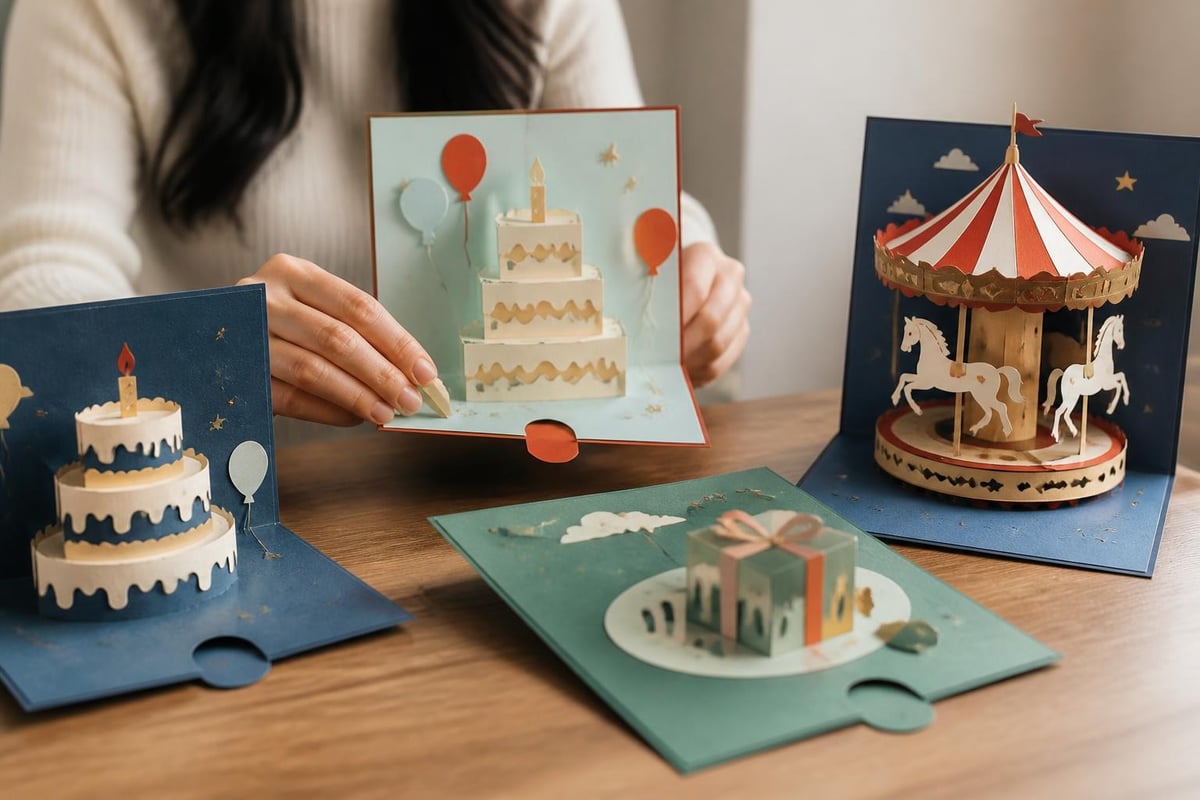
Modern consumers appreciate birthday cards that offer more than static decoration, seeking interactive elements and multi-functional designs that provide lasting value beyond the initial greeting. Laser cut birthday cards excel in this category through their ability to create complex mechanical mechanisms and transformable structures.
Popular interactive features include:
- Multi-layer pop-up scenes that reveal surprises
- Rotating elements activated by pulling tabs
- Detachable ornaments that become keepsakes
- Puzzle-like structures that recipients assemble
- Cards that transform into decorative displays
These interactive elements create memorable unboxing experiences that recipients often share on social media, providing organic marketing benefits for manufacturers and retailers. According to recent design tutorials, the integration of movement and surprise elements significantly increases perceived value and emotional impact.
Digital Integration and Augmented Reality
The convergence of physical and digital experiences represents an emerging frontier for laser cut birthday cards. Some manufacturers now incorporate QR codes, NFC tags, or augmented reality markers into their designs, linking the physical card to digital content like video messages, photo galleries, or interactive games.
This hybrid approach combines the tactile satisfaction and emotional resonance of physical cards with the unlimited creative possibilities of digital media. Recipients scan embedded codes to unlock personalized videos, virtual gift experiences, or interactive birthday wishes that extend beyond what the physical card alone can deliver.
Manufacturing Excellence and Business Applications
For businesses considering laser cut birthday cards as a product line or custom corporate greeting solution, understanding manufacturing capabilities and business applications helps identify opportunities and set realistic expectations.
Production Volume Considerations
Laser cutting technology scales effectively across different production volumes, from small batches of custom designs to large runs of popular patterns. However, the economics and workflow differ significantly based on volume requirements.
Small-batch production (50-500 units) benefits from laser cutting's flexibility, allowing profitable production of specialized designs without tooling investments. Setup time is minimal, making short runs economically viable for testing new designs or serving niche markets.
Medium-volume production (500-5,000 units) optimizes laser cutting efficiency through batch processing, material optimization, and streamlined assembly workflows. Manufacturers can justify dedicated equipment time and specialized operator training at this scale.
Large-volume production (5,000+ units) requires careful planning to maintain laser cutting's cost competitiveness against traditional methods. Success at this scale involves highly optimized workflows, potentially multiple machines running parallel operations, and efficient assembly processes.
Businesses seeking reliable high-volume production of laser cut birthday cards can benefit from partnering with established manufacturers who have invested in capacity and quality systems. The Pop up greeting card factory in Vietnam demonstrates how specialized facilities combine laser cutting technology with skilled artisan assembly to serve wholesale markets worldwide with consistent quality and competitive pricing.
Corporate and Business-to-Business Applications
Beyond consumer retail markets, laser cut birthday cards serve important functions in corporate communications, employee recognition programs, and business relationship management. Companies use custom-designed cards to acknowledge employee birthdays, celebrate client milestones, and strengthen professional relationships through personalized gestures.
The ability to incorporate corporate branding, logos, and custom messaging into elegant laser cut designs creates professional greeting materials that reflect well on the sending organization. These applications often justify premium pricing given the cards' role in maintaining valuable business relationships.
Technical Advancements Shaping the Future
The laser cutting industry continues advancing through improvements in equipment capabilities, software tools, and material science. These developments expand the creative possibilities for laser cut birthday cards while improving production efficiency.
Enhanced Precision and Speed
Recent generations of laser cutting equipment deliver improved precision and faster cutting speeds compared to systems from just a few years ago. Modern machines achieve positioning accuracy of 0.05mm or better, enabling extremely detailed patterns that were previously impractical.
Speed improvements come from more powerful laser tubes, optimized motion control systems, and advanced software that calculates efficient cutting paths. According to equipment reviews for 2026, current mid-range laser cutters operate 30-40% faster than comparable 2024 models while maintaining or improving cut quality.
These advancements reduce per-unit production time for laser cut birthday cards, improving manufacturing economics and enabling faster order fulfillment. The combination of speed and precision also supports more complex designs that might have been too time-consuming to produce economically with earlier technology.
Adaptive Design Systems
Innovative software developments enable more flexible and responsive design workflows for laser cut birthday cards. Tools like LaserSVG introduce parametric design approaches that allow templates to adapt to different card sizes, material thicknesses, or design variations while maintaining proper proportions and structural integrity.
These systems benefit manufacturers by reducing the design time required for product variations and enabling rapid customization based on customer specifications. A single base design can generate dozens of variations through parameter adjustments rather than requiring complete redesign for each option.
Material Innovation
Ongoing development of specialty papers and cardstocks specifically optimized for laser cutting expands creative possibilities while improving production consistency. Manufacturers now have access to papers with enhanced cutting characteristics, reduced charring tendencies, and improved color retention under laser exposure.
Emerging material categories include:
- Pre-scored cardstock for simplified assembly
- Dual-layer papers with contrasting core colors
- Thermochromic papers that change color with heat
- Conductive papers enabling electronic integration
- Bio-based alternatives to traditional paper stocks
As material science advances, the distinction between laser cutting capabilities and traditional techniques continues widening, making laser cut birthday cards increasingly sophisticated and appealing to discriminating consumers.
Design Resources and Learning Pathways
For designers and manufacturers entering the laser cut birthday card market, numerous resources support skill development and design excellence. Understanding where to find quality information and inspiration accelerates the learning process and improves product outcomes.
Software and Template Resources
Professional designers typically work with industry-standard vector software, though numerous alternatives serve different skill levels and budget constraints. Free options like Inkscape provide capable vector editing for beginners, while professional tools offer advanced features that streamline complex design workflows.
Template libraries and design marketplaces offer starting points for those developing laser cut birthday card lines. These resources provide professionally designed patterns that users can modify, customize, or use as learning examples to understand effective design principles.
Creating laser cut templates requires understanding how to translate creative concepts into functional cutting files that account for material properties, machine capabilities, and assembly requirements.
Community and Professional Development
Online communities, forums, and professional organizations connect laser cutting practitioners, facilitating knowledge sharing and skill development. These networks provide troubleshooting assistance, design feedback, and insights into emerging techniques and trends.
Manufacturers benefit from participating in these communities by staying current with industry developments, understanding consumer preferences, and discovering innovative approaches developed by creative practitioners worldwide.
Quality Standards and Best Practices
Maintaining consistent quality in laser cut birthday card production requires adherence to established standards and implementation of best practices throughout the design and manufacturing process.
Material Testing and Documentation
Professional manufacturers conduct thorough testing when introducing new paper stocks or design patterns, documenting optimal cutting parameters and identifying potential issues before committing to production runs. This testing phase prevents costly errors and ensures that finished cards meet quality expectations.
Documentation systems track which settings produce optimal results for each material type, creating institutional knowledge that improves consistency across different operators and production shifts. These records prove invaluable when troubleshooting quality issues or training new team members.
Design Validation Protocols
Before committing complex designs to full production, manufacturers should produce and test prototypes under realistic conditions. This validation process identifies structural weaknesses, assembly challenges, or functional problems that might not be apparent in digital design files.
Prototype testing should evaluate:
- Cut quality and edge finish
- Structural integrity during handling
- Pop-up mechanism functionality
- Assembly time and complexity
- Envelope compatibility and shipping durability
- Overall aesthetic impact
Rigorous validation prevents expensive production errors and ensures that laser cut birthday cards perform as intended throughout their lifecycle from manufacturing to final delivery and use.
Laser cut birthday cards represent a compelling fusion of technological precision and artistic expression, offering manufacturers opportunities to create distinctive products that resonate with quality-conscious consumers. As laser cutting technology continues advancing and consumer preferences evolve toward personalized, sustainable, and interactive greeting solutions, the market for these premium products continues expanding. For businesses seeking to develop exceptional greeting card offerings, partnering with experienced manufacturers who combine advanced laser cutting capabilities with skilled craftsmanship provides access to this growing market segment. The3dCards offers comprehensive pop-up and laser cut card manufacturing services, delivering the precision, quality, and creative excellence that today's market demands.